~Posted by Dave~
This blog was originally posted as a four part series over a four month period. It has been combined into one blog here for ease of reading.
Part 1
There have been many natural features over the years that have come and gone from the Beachy Head landscape, great stacks of chalk, pinnacles jutting out to sea, cracks and gullies. Now long gone we had the likes of Cuillin crack, Etheldreda’s pinnacle, Pisgah and Sunday Sport. Some receiving their names from sailors, picking out landmarks from sea to aid navigation, some named by the Victorian climbing community, drawn to the extreme challenges involved in climbing* on the unstable chalk at Beachy Head. But in this blog, I’m going to explore a pinnacle that seems to have gained more notoriety and fame amongst locals then any other, The Devils Chimney.
Where was it? Who named it? Why the Devil?
Over the next few instalments of this blog, I’m going to try and answer these questions, starting with some context on the particularly interesting relationship that the Devil has had with Sussex!
The Devil vs Sussex
According to Bede, prominent 7th century monk and historian, Sussex was one of the last areas of the country to hold on to its pagan, pre-Christian belief systems. After the Romans left, the Saxon’s arrived in the 5th century bringing with them their pagan culture, reversing any remaining pockets of Christianity from the Roman era. It wasn’t until Æthelwealh took the Sussex throne in the 7th century (having been baptised in Mercia), that the county gained its first Christian king. Sussex legend tells that this late adoption of Christianity greatly angered the Devil! Perhaps he felt Sussex was his last great stronghold, he certainly went to great lengths to prevent the spread of Christianity into the area. This story of conflict between the angered devil and the good people of Sussex is reflected time and time again in our stories and folklore, much of it connected to the landscape around us.
The Devil in the landscape
The Devil, it seems, features quite prominently in our landscape, places and geographical features from around Sussex including;
- The Devils Chimney, a now lost pinnacle of Beachy Head
- The Devils Humps, four Bronze age barrows on Bow hill
- The Devils Jumps, five Bronze age barrows on Treyford hill
- Devils Bog, Ashdown forest
- Devils Dyke, near Brighton
- The Devils Book, earthwork at the foot of Mount Caburn
The most notorious of these being Devils Dyke;
“It is said the Devil was extremely unpleased with the new churches that were popping up around Sussex, upon its conversion to Christianity, so he decided to take action! One night, he took it upon himself to attempt to dig from the sea right up through downs, with the plan to flood Sussex and drown all its inhabitants. He dug as fast as he could, needing to complete his work before sunrise so as not to be discovered, there were clods of earth flying everywhere and according to local legend, upon landing these became Cissbury, Chactonbury and an extra large one landed to form Mount Caburn. All this activity was making a right racket! And it awoke a local woman, who got out of bed and went to her window to see what was going on. She soon realised what the devil was up to and quickly devised a plan. She took a candle, lit it and held it up to her window with a colander placed in front of it. The devil looked round, saw the light and thought it was sunrise, but how could it be sunrise already he thought? Then a cockerel, who had also seen the light and believed it to be sunrise, began to crow. That was enough for the devil, he was sure it must be sunrise and made his escape to evade being caught, the job only half finished, leaving us the dyke we see today.”
There are several variations on this folk tale, many involving local saints, some claiming that the devil dropped a huge clump of earth while escaping which formed the Isle of Wight! But this is the way I understand it and have always told it and it is a great example of how we use folklore and storytelling to interpret the landscape around us. This tale is not alone in its subject matter either, there are many stories connecting the Devil to topographical features in Sussex.
In part two we will take a closer look at the Devil’s Chimney itself and begin to discover how its featured in our landscape and folklore through the century’s.
*Please note that climbing on Beachy Head should absolutely not be attempted.
Part 2
Welcome to the second part of this blog and thanks for coming back! In part one we had a look at the relationship between the Devil, the people of Sussex and the landscape. Today, we will have a look at the Devils Chimney itself and begin to explore how it fits into local legend and folklore.
The Devils Chimney
The Devils Chimney was a tall pinnacle that stood in front of Beachy head, formed as the soft chalk cliff fractures and recedes via erosion from sea and weather, leaving these huge towering monuments to where the coastline once was. Now, I use ‘a’ very loosely in that opening sentence, as it appears there has been more than one Devils Chimney! the most recent falling in 2001.
Historically, the Devil’s chimney has also referred to a steep passage way leading the cliff face from the top, as referenced in F. W. Bourdillon’s lecture to the Eastbourne Natural History Society. In fact he alludes that there is some sort of confusion between the Devils Chimney being a pinnacle when it was in fact a passage way. Also, just to add to the confusion, there was a rough ‘staircase’ that used to exist leading down to an area known as the gun garden at Beachy Head. This is often referred to as the ‘devils ladder’, but in a 1889 painting by Robert Morris titled ‘Devils Chimney and Gun Garden’, he certainly seems to be focused in on the rough staircase leading to the gun garden!
But, regardless, the opinion that the devils chimney was a pinnacle is far more widely accepted and this most certainly has been the case in more recent years, so for the sake of this blog, that is where our focus will lie.
English Mountaineer and explorer Edward Wymper writes in his diary that he visited Eastbourne between the 21st of July and 9th of August 1855. He goes on to elaborate on this visit in his famous work ‘Scrambles Amongst the Alps’ 1871;
“As we steamed out into the Channel, Beachy Head came into view, and recalled a scramble of many years ago. With the impudence of ignorance, my brother and I, schoolboys both, had tried to scale the great chalk cliff. Not the head itself – where sea birds circle, and where the flints are arranged in orderly parallel lines – but at a place more to the east, where a pinnacle called the Devil’s Chimney had fallen down. Since then we have been often in dangers of different kinds, but never have we nearly broken our necks than upon that occasion”
This forms our first account of a Devils Chimney coming and going from the Beachy head landscape.
“With the fall on Friday of the Devil’s Chimney, that familiar chalk pillar which has caught the imagination of untold numbers of visitor’s, the outline of Eastbourne’s famous headland, has somewhat changed” writes the Eastbourne Gazette. The fall is also reported up and down the country in various newspapers including Edinburgh Evening News, Hartlepool Northen Daily Mail and the Belfast Telegraph.
The most recent collapse of a Devil’s Chimney, as reported in The Argus and The Independent. The Argus reports “The Devil’s Chimney, just east of Beachy Head lighthouse, has been part of the 500ft-high cliff face for more than 50 years. It fell into the sea after heavy rain.”
So as far as we can see, there have been at least three instances a of Devil’s Chimney existing and subsequently falling. It’s interesting to note that in the 2001 fall, the Argus describes the pinnacle as being roughly over 50 years old (lining up nicely with the 1956 fall), supporting the preceding evidence that there have indeed been several Devil’s Chimneys.
It’s almost like ‘Devils Chimney’ keeps on getting recycled as the coastline changes and pinnacles come and go. Something about it just makes it keep reappearing, almost as one falls, we find ourselves another!
Local Historian, John Surtees, in his book ‘Beachy Head’ reports that after the 1956 Devils Chimney fall, Etheldreda’s pinnacle (briefly mentioned in part 1 of this blog) took on the name of Devils Chimney. This ties in nicely with information from ukclimbing.com, who report that in 2001, Etheldreda’s pinnacle was removed by a rock fall, the same date as the most recent collapse of a Devils Chimney. Further confirmation of this comes from Aleister Crowley (lots more on him later!), when he writes about his 1894 climbing attempts on Beachy Head and describes climbing both Etheldreda’s pinnacle and the Devils Chimney, so we know that two features with those names, co-existed at one point in time. This evidence makes it sound quite plausible that we are looking at an existing pinnacle adopting the name ‘Devils Chimney’, as another is lost. There are also many references to one of the ‘Charleses’ (three large rectangular pinnacles that stood at Beachy Head, now long lost around 1850) becoming a Devils Chimney, once reduced to a pointy stub by weather and erosion. In fact, it’s quite possible that Etheldra’s pinnacle was once a Charles and then subsequently a Devils Chimney!
So, why is the name being recycled? Could this have been a conscious decision to choose a new Devils Chimney once one had been lost? Perhaps the name ‘Devils Chimney’ is just so notorious that it’s the first thought that comes to people’s minds upon seeing a pinnacle at Beachy Head? Personally, I would go with the later of the arguments, as we can see, the 1956 collapse was being reported countrywide, demonstrating that the ‘Devils Chimney’ enjoys fame and importance not just in Eastbourne, but well outside of the local area too.
The prominence of folklore surrounding the Devil in Sussex (as discussed in part one), must be playing a part here too and as we saw previously, the Devils Chimney was not the only devil named feature at Beachy Head. Although local folklore thinks of it being thrown up from below, rather than having been separated out from the sheer chalk cliff it stands beside. On the Devil’s Chimney, leading Sussex folklorist Jacqueline Simpson writes,
“…the story was that the Devil had built this chimney in order to smother the earth with smoke from hell, but just as he was finishing it a ship sailed by, and the cross formed by its mast and yard frustrated his evil plan…”
Much like the local legend of Devils Dyke (from part 1), we see a theme of the Devil plotting to unleash havoc and destruction, but is scuppered at the last moment! This is a common theme that runs throughout Sussex folklore concerning the Devil and the rest of the country for that matter too. The Devil pretty much always loses!
In part three of this blog, we will have a look into Aleister Crowley and his notorious relationship with the Devils Chimney and Eastbourne. Investigating the folklore and separating myth from fact.
Part 3
Welcome to the third part of this blog. In the last instalment of this blog, part two, we touched on some of the folklore surrounding the Devils Chimney, with the little-known legend that it was thrown up from hell by the Devil himself to smother Earth with smoke. But there is a far more famous legend locally about how the Devils Chimney got its name and it involves the notorious occultist, Aleister Crowley.
When the Devils Chimney is mentioned locally, there’s often a name mentioned not soon after, Aleister Crowley. Local legend tells us that he placed a curse on the town of Eastbourne…
When the Devil’s Chimney falls, Eastbourne will fall with it!
Well, the Devils Chimney has fallen multiple times, as we explored in the second part of this blog series and Eastbourne is still standing! But regardless, it’s a fascinating bit of more recent folklore and warrants some closer investigation!
Edward Alexander Crowley arrived in Eastbourne aged 19, in 1894. He had been sent to the town to continue his studies with a tutor named Lambert, having not been getting on well with boarding school. Lambert was a Plymouth Brother, a member of the nonconformist Christian Plymouth Brethren, of which Crowley’s father was an evangelist. Crowley was a poet, a talented chess player, a reluctant academic and most importantly for the context of this blog, a keen mountaineer. During his stay in Eastbourne, between helping out Professor Hughs in the Chemistry department at Eastbourne College and playing chess at the local club, he also indulged in what was at the time his favourite activity, climbing.
The soft and loose chalk cliffs presented immense challenges to anyone who dared to attempt to climb at Beachy Head, with very few of the Victorian English climbing community, understandably, going anywhere near it. But Aleister Crowley liked to push boundaries and himself, so from April onwards in 1894, he made several attempts at climbing the various pinnacles, cracks and gullies around Beachy Head, many now long eroded away.
So, did Aleister Crowley name the Devils Chimney?
Well, it’s certainly commonplace for climbers to name new routes that they discover, especially if they can lay claim to being the first to conquer them. Aleister Crowley certainly did climb the Devils Chimney, his climbing exploits at Beachy Head are very well documented in an entry he wrote for the 1895 Scottish Mountaineering Journal.
“On July the 4th (1894) we made an attack on the Devil’s Chimney, a magnificent pillar of rock which projects boldly from the main cliff at a point rather to the W. of Etheldreda’s pinnacle. “Devil’s Chimney is a local name, and, as far as “chimney” goes, misleading to climbers. Nobody, however, who has been twice on the summit, as I have, will entertain the smallest doubt as to its ownership.”
So, as we can see from this quote, Aleister Crowley states that the Devil’s Chimney was already named as such by locals before his arrival in the area. This is of course backed up by part 2 of this blog, where we can see that the use of the name ‘Devils Chimney’ goes back at least 50 years prior to Aleister Crowley visiting Beachy Head. Although it looks like Aleister Crowley did name some features at Beachy Head while climbing. ‘Grants Chimney’, another pinnacle neighbouring Etheldreda’s pinnacle, was named after his cousin and climbing partner, Gregor Grant. Also, the much-mentioned Etheldreda’s pinnacle was in fact named after his dog!
This same evidence also disproves any theories that The Devils Chimney could have been named after Aleister Crowley, despite the undisputable presence that he had in the Beachy Head landscape, but let’s take a look at the most persistent of those theories, the curse…
Did Aleister Crowley curse Eastbourne?
Well, there are several variations on this story that I’ve heard over the years, but the most common seems to be that Aleister Crowley made an attempt at climbing The Devils Chimney, got stuck halfway up and then got laughed at by a few locals due to his predicament. This subsequently led to Crowley seeking revenge on Eastbourne locals for laughing at him and he placed a curse on the town, stating that when The Devils Chimney eventually fell into the sea, Eastbourne would fall with it!
So, we’ve already seen that Aleister Crowley did indeed climb on the Devils Chimney, several climbing attempts are documented, but amongst those accounts there are none of him getting stuck. It could be reasonable to think that such an embarrassing incident for a climber, could be omitted from any personal accounts, but in his entry in the Scottish Mountaineering Journal he speaks in great detail about an incident when he got stuck climbing ‘Cuillin crack’ at Beachy Head and had to be rescued by the coast guard! So this would lead me to believe, that there was no such incident involving The Devils Chimney.
Aleister Crowley was only 19 years old when he climbed at Beachy Head, although in his writings from around this time you can certainly start to see the beginnings of what would become a lifelong interest and involvement in the occult, I don’t think that he was practicing magick at this point in his life. So, I personally find it highly unlikely that he would have placed a curse or spell on Eastbourne, at that point in time anyway. It’s not to say that he couldn’t have remembered the incident and placed a curse some years later! But it’s not something that I’ve come across during my research into Aleister Crowley and it’s not something he mentions in his Autohagiography ‘The Confessions of Aleister Crowley’, in which he discusses his time in Eastbourne and Climbing at Beachy Head in some detail.
But, just in case, local white witch Kevin Carlyon held a cleansing ceremony at Beachy Head when the Devils Chimney fell, which was reported in national newspapers at the time, bringing rumours and legends of Aleister Crowley cursing Eastbourne, back to the forefront of the public mind.
Join me for part four, the final instalment of this of this blog. Where we will try and draw a conclusion about The Devils Chimneys and find out if we have answered the questions we set out to answer. Where was it? Who named it? Why the Devil?
Part 4
Welcome to the 4th and final entry of this blog series and thanks for sticking around! In this instalment, we are going to draw to a conclusion on The Devils Chimney (the best we can!) and ask, have we answered our original three questions about the Devils Chimney? Where was it? Who named it? Why the Devil? Well, I’m going to attempt to present a couple of theories based on the evidence from the last three instalments of this blog.
Where was it?
As we’ve come to realise over the last three instalments of this blog, it turns out that “where was it?” was not really the question we should have been asking! A more appropriate question, as we have now discovered, would have been “where were they?”.
In the second part of this blog, we looked at there being three distinct instances of Devils Chimneys collapsing, one pre 1855, one in 1956 and the most recent in 2001. All these occurred in a relatively small area of Beachy Head, just to the East of the Beachy Head Lighthouse. So why were they all basically next to each other?
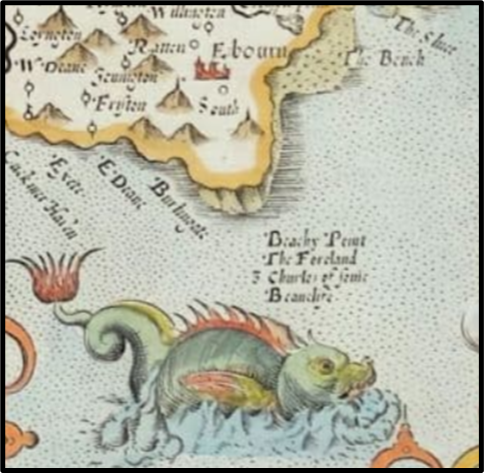
As mentioned in the second part of this blog, long before any mentions of Devils Chimneys in the Beachy Head area, we have ‘the Charleses’, a prominent feature in the Beachy Head landscape. I won’t go into too much detail here, but the Charleses in a nut shell, were a number of towering pillars of chalk of quite a square shape, topped off with grass and level with the very top of the sheer chalk face. These are the result of sections of the cliff fracturing and beginning to move away from the front of the main headland. Over the years, as these get worn by the weather and action of the sea, they begin to crumble and fall apart, leaving a more jagged type of structure. I am of the opinion that the two pinnacles (the Devils Chimney and Etheldreda’s pinnacle) mentioned in this series of blogs are the result of the weathering process on The Charleses.
Please see the blogs on this website about The Charleses, for a far more in depth description and history of the Charleses.
The Charleses seem to feature in various maps and references from about the early 17th century onwards, but of more relevance to us, is when the last one fell and most sources seem to place that at some time around the early 1850’s. One of those sources is “Beachy Head, a paper read before the Eastbourne Natural History Society” by F. W. Bourdillon, published 1885. A valuable resource for anyone looking to build up an image in their mind of The Beachy Head landscape of the 19th century. Bourdillon suggests that the collapse of the last Charles is the collapse of the Devils Chimney, that Mountaineer and explorer Edward Wymper talks about in his 1871 work ‘Scrambles Amongst the Alps’, our first reference to a Devils Chimney collapsing. I have to say that I agree with him. I think that the name ‘The Devils Chimney’ first came into being as a nickname for one of The Charleses, most likely the last of them to fall, which leads us nicely onto our next question….
Who named it? Why the Devil?
I’m going to answer these two questions together, for the sake of keeping on topic and this blog not getting too long!
In part two of this blog I talked about the idea of the ‘Devils Chimney’ being recycled, the legend of the Devils Chimney persisting from generation to generation. As one pinnacle fell, a neighbour inherited the legend and had there moment with all the fame a notoriety that comes with such a prestigious title. But what I didn’t really touch on, is how it all started, how the name ‘Devils Chimney’ came to be in the first place…. Here is my theory….
When looking at the Beachy Head landscape the vast majority of us would have viewed these great pinnacles from above, stretching out to the sea below us as we stroll across the headland. But I want us to try and think about how these huge columns of chalk would have looked to the sea-faring community, be that fisherman or sailors, when viewed from sea level towering up in front of Beachy Head. Now the sea around Beachy Head was a treacherous place for sailors and fisherman, particularly in stormy conditions, even more so before any kind of lighthouse or attempts to shelter stranded sailors were introduced. In a very severe storm, on a cold dark night, driving rain, gale force winds, jagged rocks below you ready to rip your vessel wide open at any moment! I think it would quite reasonable to assume that under those conditions, Beachy Head could certainly be perceived as the work of the Devil, or some sort of hell on earth.
The celebrated Eastbourne historian The Rev. Walter Budgen when writing of Beachy Head in his 1925 ‘Illustrated Guide to the Church Congress and Church Congress Exhibition’, spoke about old Venetian sailor men referring to the area as “Caput Doble” (i.e Diaboli, The Devil) on account of the unfriendliness and danger of the outlying rocks. Which adds further weight to the argument that the ‘Devils Chimney’ came into being by those who viewed it from below, not from above. I would also like to cast our minds back to end of the second part of this blog, where we had a look at the local folklore surrounding the Devils Chimney….
“…the story was that the Devil had built this chimney in order to smother the earth with smoke from hell, but just as he was finishing it a ship sailed by, and the cross formed by its mast and yard frustrated his evil plan…”
Now anyone who has ever taken the time to look up at Beachy Head from Eastbourne seafront, may have noticed that on occasion the summit can be engulfed in low cloud or a thick mist, just hanging motionless, like the smog above the tall chimneys of some great 19th century industrial area on a still day. Let’s think about how that would look to a sea-farer… (particularly a superstitious sea-farer and sailors are renowned for their superstitions and folklore, even having their own ‘sea-devil’ who dwelled below, commonly known by the name of Davy Jones)…..a great column of chalk over 500ft high, the very top protruding into this thick grey layer of fog like some humongous chimney belching out smoke, rising upwards from an area they liken to hell…… I think we can certainly begin to perceive how they would have thought of this great chimney to be the work of the Devil… The Devils Chimney.
Thank you very much for sticking with me and reading through this blog. Have we answered the questions we set out to? Well we have had a good go at it at the very least! We’ve presented a theory on the Devils Chimney, tried to find that point at which historical fact and folklore cross over and probably actually thrown up even more questions then we started out with! But, we will leave those for another day. Thanks, Dave.







 Heritage Eastbourne